
Watch: Circular Fashion Collaboration Feat. Beyond Remade x Seasalt Cornwall
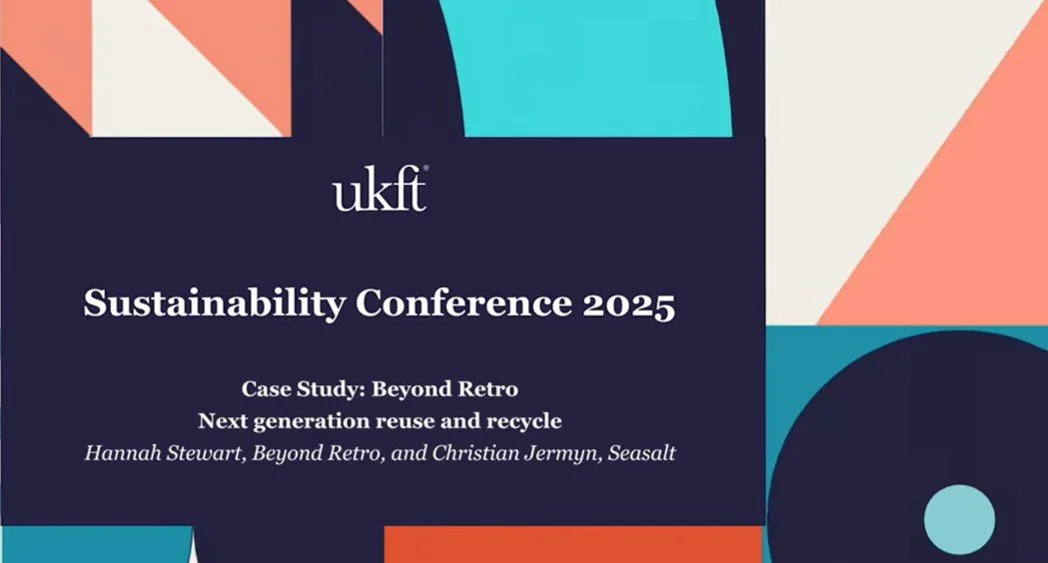
At the UKFT Sustainability Conference 2025 in London, UK, more than 250 leaders from across fashion, manufacturing, research, innovation, and policy gathered to explore practical, real-world progress in circularity. One of the clearest examples came from this panel, featuring circular fashion experts from Beyond Remade, the specialist manufacturing division of Bank & Vogue, and Seasalt Cornwall, the leading UK fashion brand, who discussed how post-consumer textiles can be transformed into commercially desirable products at scale.
Quick Summary
A concise overview of how Beyond Retro and Seasalt Cornwall demonstrated a scalable circularity model at the UKFT Sustainability Conference 2025, presented by Hannah Stewart (Beyond Remade), Hugo Harris (Beyond Remade), and Christian Jermyn (Seasalt Cornwall). The session showed how post-consumer textiles can become high-value, commercially desirable products.
Beyond Remade and parent company Bank & Vogue apply a structured value hierarchy: resell what can be reworn, upcycle what can be improved, and convert the rest into components for new manufacturing.
Their facility in the Kandla SEZ, a global sorting and processing hub for post-consumer textiles in northern India, transforms used garments into ready-to-use material components for new production.
Christian Jermyn, Director of ESG, Seasalt Cornwall, emphasized that customers respond first to design and desirability, with circularity becoming a meaningful story once the product already resonates.
Hugo Harris, Head of Product, Beyond Remade, said an environmental study from a similar collaboration with global fashion brand Coach showed an 80% reduction in carbon emissions and a 95% reduction in water use compared to what he called “first life denim” and that these savings still held even after accounting for shipping raw materials to India for processing and then on to Vietnam for final manufacture
The collection connected with both long-time and new customers, demonstrating that circular design appeals well beyond younger demographics.
The partnership illustrates how circularity scales through strong operational systems rather than sustainability slogans.
Together, the three presenters demonstrated a practical waste-to-value model that delivers both commercial relevance and environmental benefit.
Circularity can feel abstract. Acronyms and policy frameworks dominate the conversation, but the real test is simple: Can we turn post-consumer garments into products people genuinely want, at commercial scale, without creating new waste?
This partnership shows that the answer can be yes.
Built Around Value, Not Waste
As the specialist manufacturing division of Bank & Vogue, Beyond Remade can operate as either a Tier 1 manufacturer (Full Cut & Sew service) or a Tier 2 supplier (Upcycled Component Manufacturing), depending on brand partner needs.
This work begins with the reality of the secondhand textile stream: a large share of donated garments never makes it onto a charity shop floor, and many that do still go unsold. Bandk & Vogue’s mission is to help turn those unsold materials into higher-value outputs through a clear hierarchy:
Resell what can be reworn
Upcycle what can be improved with minimal intervention
Convert the rest into components for new manufacturing or recycling
A key part of the process is their manufacturing facility in India’s Kandla SEZ, located at the center of global post-consumer textile flows. There, teams sort, scan, triage, and manufacture components that integrate directly into tier-one production, supported by standard compliance processes.
This turns post-consumer garments into viable raw materials for brands that would normally rely on first-life textiles.
Circular Fashion Collaboration: In Their Own Words
Below is the UKFT conference segment where Beyond Remade and Seasalt Cornwall walk through the model, why it works, and how customers responded.
“We’ve got to make circularity accessible, engaging, and inclusive. We have to stop punishing people for their choices and instead give them better choices.”
From Seasalt’s perspective, circularity must be engaging, accessible, and inclusive. Most customers do not buy sustainability; they buy products they love. If the product is beautiful first, the sustainability story becomes something they naturally share. This collaboration confirmed the point: customers responded to the design, not the sustainability positioning, and only later discovered the waste-to-value story behind each piece.
It also resonated with a demographic often overlooked in circularity efforts: older customers. The collection actually broadened appeal, signaling that circular fashion is not limited to a youth niche but can thrive across age groups with the right storytelling and design.
For anyone exploring circular product strategies, this case study offers a simple lesson: scale comes from systems, not slogans. Start with the textiles already on the planet, build a repeatable process, and create products people truly want.
Explore Circular Fashion Partnerships
Want to learn more about how Upcycled Component Manufacturing works?
Get in touch to book a discovery call.