
What eBay’s Circular Fashion Fund Signals About the Future
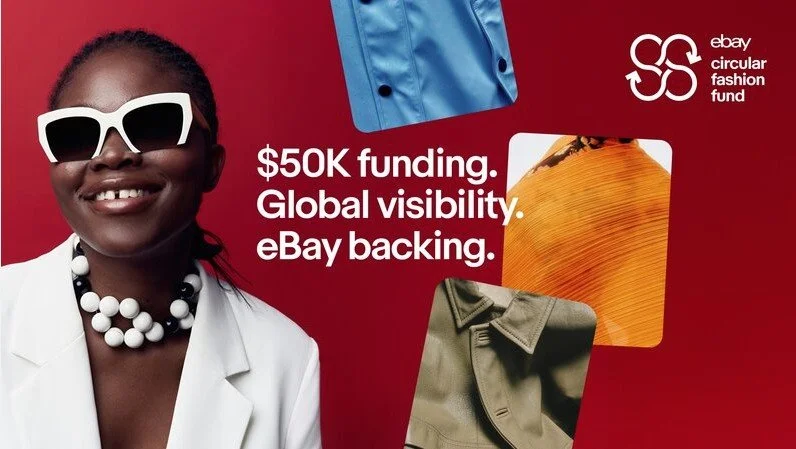
Backing the infrastructure behind circular fashion
Capital is moving toward the systems that make circular fashion work.
TL;DR
Ebay’s 2026 expansion of its Circular Fashion Fund into Canada, the EU, and Switzerland provides an interesting signal for industry leaders trying to stay on top of where circular fashion is moving next:
Capital is increasingly targeting infrastructure and enablement, not pilot projects
Circular fashion is being treated as a systems challenge rather than design experiments
Mentorship, partners, and network access are being prioritized alongside funding
Scale is defined by integration into real supply chains, not pilots or proofs of concept
Taken together, this points to a more execution-focused phase for circular fashion, where operational capability matters as much as innovation.
Funding Is Shifting Toward Execution
For 2026, eBay has opened applications for its Circular Fashion Fund to businesses and startups across new regions, selecting eight companies to receive funding and support, with one global winner eligible for additional investment through eBay Ventures. Since launching in 2022, the program has supported more than 25 businesses working across textile recycling, resale, repair, and enabling technologies.
What makes this expansion notable is not the size of the fund, but where attention is being placed.
The program is backing solutions that help circular fashion function day to day, rather than concepts designed to prove intent. These are businesses focused on material intelligence, recovery, sorting, and operational tooling that make circular systems workable at scale.
As Alexis Hoopes, VP & Global Head of fashion at eBay, said in the company’s announcement:
“When we launched the Circular Fashion Fund, we set out to support the businesses turning circularity from ambition into action. With this expansion, we’re helping more founders build the infrastructure to make circular fashion an integral part of the fashion industry.”
That framing reflects a shift away from experimentation and toward scaled execution.
How Distribution Shapes What Scales in Circular Fashion
Digital marketplaces such as eBay, Depop, Vinted, and ThredUP help extend product lifecycles and concentrate demand, making circular fashion accessible at scale.
What eBay’s announcement highlights is the need for an integrated supply chain for circular fashion, one that fits alongside existing processes while introducing innovation in adjacent areas like recovery, reuse, upcycling, and remanufacturing.
This is where partners like Beyond Remade play a critical role, working with brands to connect circular manufacturing into real-world supply chains so circular fashion can operate reliably at scale.